
What changed, and why it matters
The real story in OpenAI expands image provenance with C2PA, SynthID, and a public verification tool is not that one more AI company added another trust label. The real story is that image provenance is finally becoming visible enough that newsroom, policy, and platform teams may start treating it as an operational signal rather than a research talking point.
That matters for how to detect ai-generated images because the hardest cases rarely arrive as neat demos. They arrive as fast-moving claims, reposted files, cropped screenshots, and political or celebrity images that need a publish-or-hold decision before certainty is available.
The shorter answer
If a file is going viral, do not ask which single layer can "prove" the answer. Ask what provenance, metadata, detector output, and visual context each contribute, and where each layer stops being reliable.
News Peg
The immediate trigger for this workflow is OpenAI's provenance update published on May 19, 2026. The official announcement is here.
A real review scenario
Picture the most common failure mode: a dramatic image starts spreading on X, Telegram, or WhatsApp with a caption claiming it proves a breaking event. One editor finds no obvious visual artifact. Another sees a detector score that looks suspicious. A third person downloads a reposted JPEG that no longer carries much metadata. This is exactly the kind of case where teams overreact to whichever signal appears first.
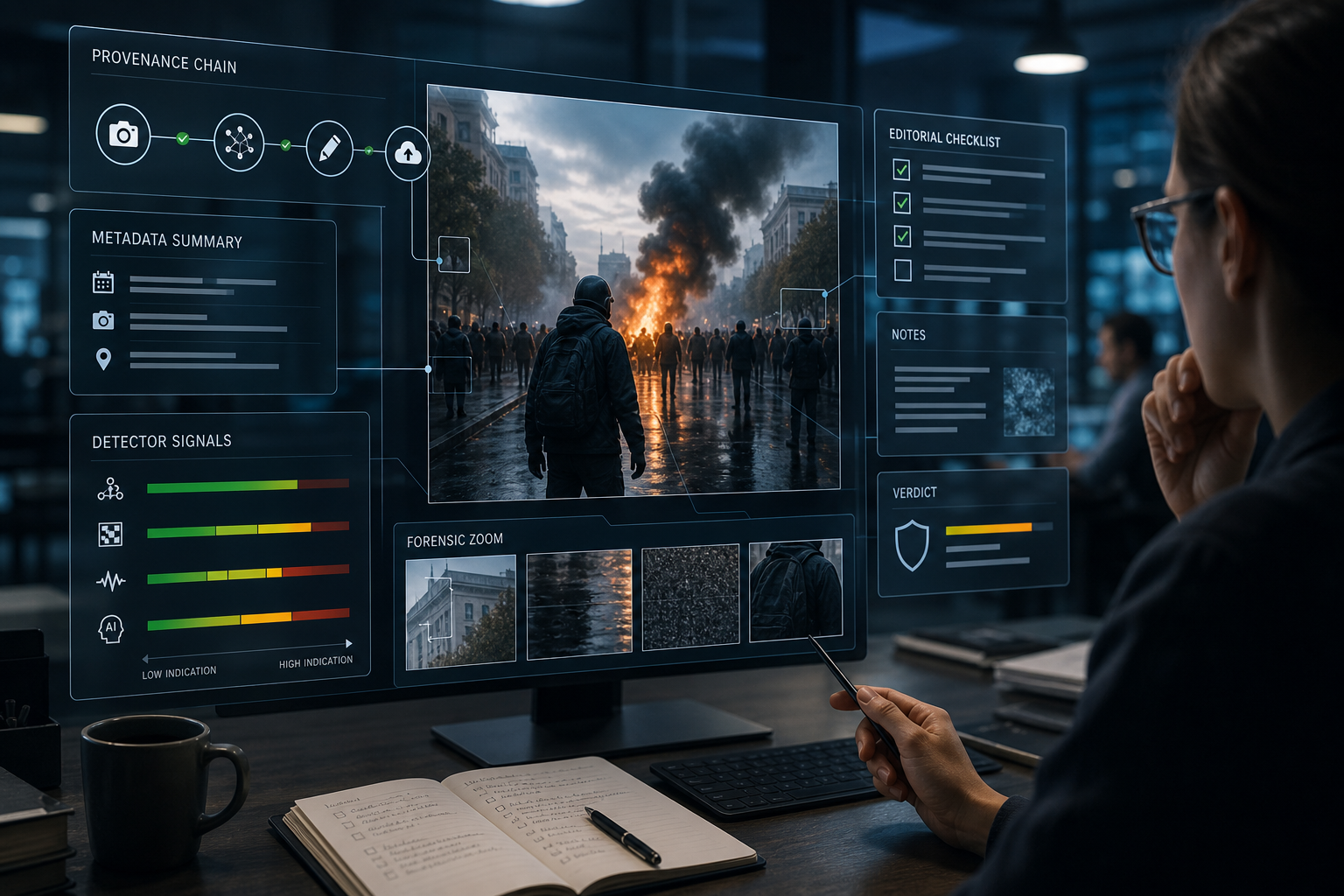
A better workflow is slower by a few minutes but safer by a mile: check whether Content Credentials or provenance survive on the original file, inspect EXIF and edit history clues, compare detector output without treating one score as a verdict, then bring the visual claim back into story context. The output should read like an evidence log, not like a magic trick.
Signal by signal
- Provenance and C2PA are strongest when the chain is intact and the file has not been stripped in transit.
- EXIF and adjacent metadata are useful for timeline reconstruction, but reposts and edits often destroy that layer.
- Detector scores are useful for triage and prioritization, not for courtroom-style certainty.
- Visual reasoning matters most when the technical layers disagree or arrive incomplete.
What a useful review output looks like
Even without a screenshot, the workflow still depends on provenance, metadata, detector output, and human review working together.
Why this matters operationally
For journalists, the win is not discovering a perfect signal. It is building a review trail that shows what was checked, what was missing, what remained ambiguous, and why the final decision was to publish, label, hold, or escalate.
Continue with methodology, sample reports, or Run a free review.